
Thought leadership

Leading Design Transitions in an Age of AI and Disruption

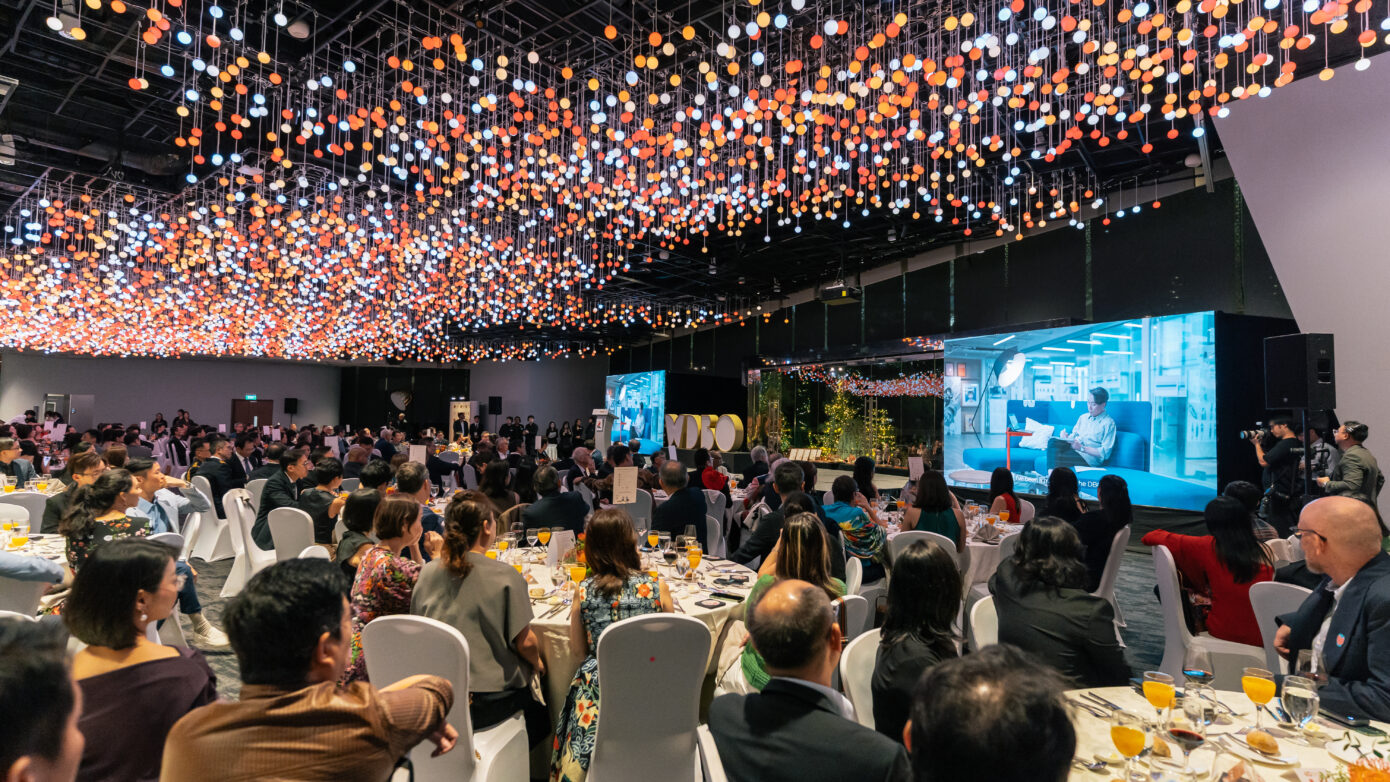
Leading Design Transitions in an Age of AI and Disruption 2560 1707 Design Business Chamber Singapore

We stand at the precipice of profound shifts across many aspects of our lives. Artificial Intelligence and rapid technological, social, environmental and economic disruptions are fundamentally rewriting the rules of business, dismantling traditional models, and altering how we live and work. In this rapidly shifting landscape, how do we leverage design as more than a means of competitive differentiation, to create flourishing worlds that serve us and our future generations to come?

Design is an essential navigational tool in these times as we strive to be good ancestors.

This is why the Design Business Chamber Singapore (DBCS) is championing the theme: “Leading Design Transitions.” To lead a transition means we cannot afford to be reactive. We must anticipate changes and paths, shape them, and ensure that as technology accelerates, our solutions remain deeply respectful of the foundation of human talent and planetary resources that all good business depends on. While AI automates the predictable, design provides the empathy, ethical grounding, and strategic foresight necessary to turn complex disruptions into avenues for sustainable enterprise development. 

Navigating this new era cannot be done in silos. It requires a unified, global effort. This is why DBCS is in partnership with fellow Singapore design associations through DesignS, in strategic alignment with our global body, the World Design Business Organisation (WDBO), to step up to create impact through two core pillars: Convening and Solutioning.

Convening the Global Ecosystem:
We act as a vital nexus connecting designers, C-suite business leaders, technologists, and policymakers through the World Design Business Forum. By leveraging the expanding WDBO network, we are facilitating cross-border dialogues and bringing together diverse, multidisciplinary minds. Through international forums, galas, and industry dialogues, we create the brave spaces necessary for stakeholders to debate the ethical implications of AI and other driving forces, widen our understanding, share insights, and forge powerful partnerships.


Driving Actionable Solutioning
:
Beyond conversation, we are committed to tangible outcomes. DBCS and WDBO are actively working to equip businesses with the frameworks needed to integrate design into their core corporate strategies. By benchmarking excellence—through platforms like the Singapore Good Design (SG Mark) and the Design Power Index—we highlight proven global design best practices. We are creating a repository of knowledge and strategies that empower enterprises to use design not just to adapt to the changing world, but to actively build the new products, services, and business models of tomorrow.


Let us not see the age of AI as threat to the design and business communities; rather, it is our greatest canvas yet. Let us not just weather the storm of disruption. Let us imagine worlds worthy of our passions and design the transitions to get there.

I invite you to join DBCS and WDBO on this journey to lead with proactive, purpose-driven design.

Authors
By Hong Khai Seng, President of DBCS


PostInsta PostFB PostLinkIn PostYT PostOther

Like what you read?
Follow us on Instagram, Facebook, Linkedin and Youtube to get the latest updates!


Related Post

Design in the Age of AI: Why Human Direction Matters More Than Ever

Design in the Age of AI: Why Human Direction Matters More Than Ever 7780 5305 Design Business Chamber Singapore

AI Is Changing Design, Not Replacing It

Artificial intelligence is changing design, but not by replacing designers. It is changing design by shifting where value is created, where time is saved, and where human judgement matters most. In my view, this is the central point the design industry must now engage seriously: AI is not the end of design expertise. It is a new condition for how design expertise is expressed.

For many years, design has been understood through familiar process models centred on discovery, definition, development, and delivery. That basic arc remains useful. What is changing is the intensity and speed of what happens inside it. AI expands the range of concepts that can be explored, accelerates research and synthesis, supports visualisation, assists communication, and helps teams examine broader sets of alternatives earlier in the process. The practical effect is that design is becoming more generative, more iterative, and more strategically responsive.

DBCS Hosted a panel with Singapore’s Design Trade Associations, exploring how AI is transforming design. Panelists: AAMS: Geoff Tan, Michelle Leong, Jolyn Heng, Dawn Lum; SIA (Singapore Institute of Architects): Tiah Nan Chyuan; SILA: Yvonne Tan; IDCS (Interior Design Confederation Singapore): Cameron Woo, Divya Anthony; SFIC (Singapore Furniture Industries Council): Gabriel Lim, Joshua Koh, DBCS, Khai Seng Hong Moderator: Bradley Camburn

A Larger Design Space

This should be seen as an opportunity. AI allows designers to engage larger spaces of possibility than was previously practical. It can help teams surface material options, frame stakeholder discussions, test scenarios, and communicate directions with greater speed and clarity. In complex environments, that matters. Singapore’s design sectors frequently operate across technical, regulatory, cultural, and commercial constraints. In such contexts, tools that improve coordination and accelerate informed iteration are not marginal improvements. They can materially strengthen design performance.

AI also appears especially valuable in the earlier and middle stages of the process, where breadth matters. It supports the generation of alternatives, comparison of pathways, and exploration of multiple possible futures before teams commit resources to final execution.

Why Human Guidance Becomes More Important

Yet the emergence of AI also makes one point clearer, not weaker: the final product still needs human guidance. AI may play a heavier role in concept development, but people remain responsible for contextualisation, prioritisation, ethical judgement, and detailed final design. Designers still determine what matters, which trade-offs are acceptable, what is appropriate for the user, and what should ultimately be built. Those decisions are not secondary. They are the core of responsible design practice.

In other words, AI can expand the design space, but humans still define the direction of travel. That is why the future of design is not less human. It is more intentionally human.

A New Process Logic for Design and AI

This is consistent with the tri-diamond framing we have been developing, which positions design as an interaction between human intention, AI’s latent generative space, and human evaluation. In this view, AI is strongest when expanding and transforming possibilities, while humans remain essential in setting direction and evaluating outcomes. The model also reflects an important practical observation: AI use tends to be more intense in the define and develop phases, while humans retain a stronger leadership role in discovery and delivery. 

Immanuel Koh, Triple-Diamond, 2026.

Further, the integration of design and AI does not occur in a single fixed way, but across six distinct modes with varying levels of automation and human involvement: intuition, deliberation, surrender, autopilot, offloading, and recursive. Together, these modes show that design with AI can range from predominantly human-led processes, to AI-accelerated collaboration, to highly automated loops, depending on how intention, generation, and evaluation are distributed between human judgement and artificial systems.

Immanuel Koh, Triple-Diamond & Its Modes, 2026.

Singapore’s Opportunity

For Singapore, this moment calls for ambition. We should not approach AI in design as a narrow question of tool adoption. We should approach it as a question of capability, leadership, and strategic identity. If design is evolving with AI, then Singapore has the opportunity to help define what that evolution looks like: human-led, outcome-focused, and globally relevant.

That is the opportunity now in front of the design industry. Not simply to use AI, but to shape how design evolves with it.

Authors
By Bradley Camburn DBCS & Immanuel Koh SUTD


PostInsta PostFB PostLinkIn PostYT PostOther

Like what you read?
Follow us on Instagram, Facebook, Linkedin and Youtube to get the latest updates!


Related Post